
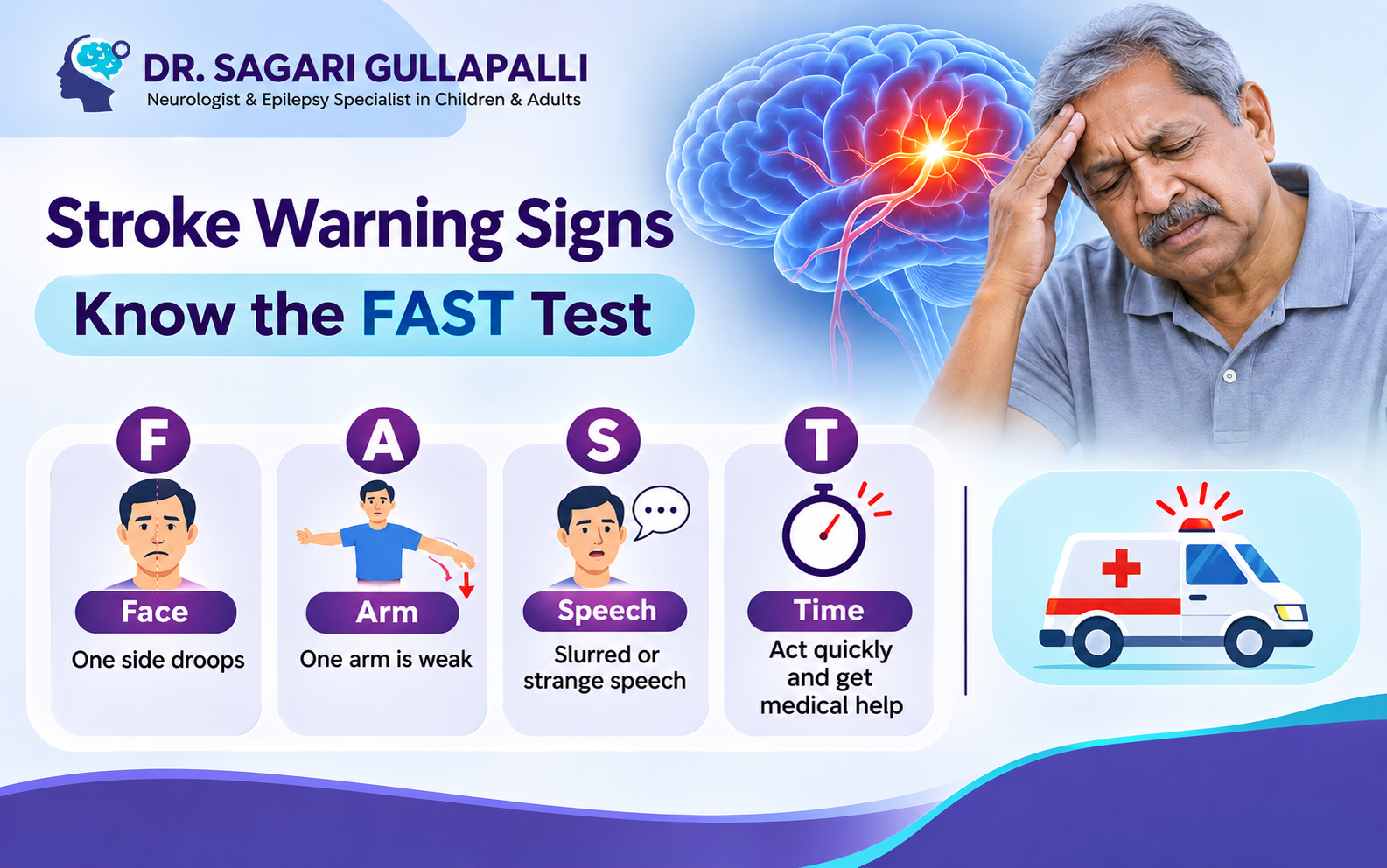
Imagine you are having tea with your father. Suddenly his smile looks crooked, his words slur, and the cup slips from his hand. This could be a stroke, and in a stroke, every minute counts.
Doctors say, “Time is brain.” During a stroke, blood flow to the brain is cut off, and nearly 2 million brain cells can die every minute without treatment. Quick action can save a life and prevent long-term disability. In India, many patients reach the hospital too late because the signs go unrecognised. That is why families look for the Best Neurologist in Hyderabad, both for emergency guidance and for long-term prevention.
In this guide, you will learn the FAST and BE-FAST tests, the warning signs people miss, what to do in an emergency, and how to lower your risk.
A stroke happens when the blood supply to part of the brain is suddenly blocked, or when a blood vessel in the brain bursts. Without blood, brain cells start to die within minutes.
|
Type of Stroke |
What Happens |
Key Point |
|
Ischemic stroke |
A clot blocks a blood vessel in the brain. |
The most common type. Clot-busting treatment may help if given early. |
|
Hemorrhagic stroke |
A weak blood vessel bursts and bleeds. |
Often linked to very high blood pressure. |
|
TIA (mini stroke) |
A short-lived blockage. Symptoms fade in minutes. |
A warning sign. Never ignore it. |
Only a brain scan can tell which type it is, so never wait at home to “see if it goes away.”
Think of the brain as a city whose power has suddenly failed. The longer the outage lasts, the more of the city goes dark. The sooner treatment starts, the more brain can be saved. Clot-busting medicine can be given to selected ischemic stroke patients, usually within 4.5 hours of the first symptoms. A clot-removal procedure (thrombectomy) may help selected patients with a large blocked vessel, sometimes up to 24 hours after symptoms begin.
Reports suggest that only a small share of stroke patients in India reach the hospital within this window. Most delays happen at home, when families wait, hope it passes, or try home remedies. So when you notice the signs, act at once.
|
Letter |
What to Check |
What to Look For |
|
F – Face |
Ask the person to smile. |
One side of the face droops. |
|
A – Arm |
Ask them to raise both arms. |
One arm drifts down. |
|
S – Speech |
Ask them to repeat a simple sentence. |
Speech is slurred or strange. |
|
T – Time |
Note when symptoms began. |
Call for emergency help right away. |
Doctors now use BE-FAST, which adds two more checks because FAST can miss some strokes:
The key word is “sudden.” A headache that builds slowly may have other causes, but a sudden change in the body or brain needs urgent attention.
Women and Younger Adults
Women may also report nausea, extreme weakness, fainting, or hiccups that do not stop. These look “vague” and are often missed. Stroke is also not only a disease of older age. Doctors in India are seeing strokes in people in their 20s, 30s, and 40s, often linked to high blood pressure, diabetes, smoking, and stress. Never assume, “I am too young.”
A TIA has the same signs as a stroke, but they fade within minutes. Many people feel relieved and do nothing. This is a serious mistake, because a bigger stroke may follow within days. Even one short episode needs urgent medical attention. Do not wait for a second episode before you act.
Do’s
Don’ts
Low blood sugar, migraine with aura, seizures, and some ear problems can look like a stroke. Only a doctor, with a quick check and a brain scan, can tell the difference. This is why you should never guess at home. When in doubt, treat it as a stroke and get to the hospital.
Risk factors you can control: high blood pressure (the biggest one), diabetes, high cholesterol, smoking and tobacco, heavy alcohol use, obesity, lack of exercise, irregular heartbeat, and long-term stress.
Risk factors you cannot control: age, family history of stroke, and a previous stroke or TIA.
If you have several of these, a check-up with a neurologist can help you understand your personal risk and plan prevention.
Doctors check face, arm, speech, vision, and balance, test blood sugar (low sugar can copy stroke signs), and do a CT scan to look for bleeding. An MRI, scans of the blood vessels, an ECG, and blood tests may follow to find the cause and guide treatment. Not every patient needs every test.
Emergency stroke treatment is given in a hospital with stroke facilities. Afterwards, a neurologist helps with medicine reviews, risk control, and recovery planning.
Most strokes can be prevented. Small daily habits add up.
|
Myth |
Fact |
|
Stroke only happens to old people. |
False. Younger adults can have strokes too. |
|
If symptoms go away, there is nothing to worry about. |
False. It could be a TIA, a warning of a bigger stroke. |
|
Pricking the fingertips or a home remedy helps. |
False. It delays real treatment. |
|
Give water or food to make the patient strong. |
False. The person may choke. |
|
Stroke is the same as a heart attack. |
False. A stroke affects the brain, while a heart attack affects the heart. |
|
Stroke cannot be prevented. |
False. Controlling blood pressure, sugar, and lifestyle lowers the risk. |
Recovery is different for every person. Some people recover quickly, while others need months of therapy. Families play a big part. Follow the medicine plan every day, start physiotherapy and speech therapy as early as advised, and make the home safe by removing loose mats and keeping floors dry. Watch for low mood or worry, because many survivors feel sad or anxious. With patience and regular follow-up, many people return to an active life.
Go to the nearest hospital emergency immediately if there is a sudden droop of the face, weakness of an arm or leg, slurred speech, loss of balance or vision, or a sudden severe headache.
Book a visit with a neurologist soon if you have had a stroke or TIA before, have high blood pressure, diabetes, or high cholesterol, have a family history of stroke, or have repeated numbness, dizziness, or short spells of weakness.
Dr. Sagari Gullapalli is a neurologist who treats adults and children, with a special focus on epilepsy and seizure disorders, along with other brain and nerve conditions. Patients can expect:
In a stroke emergency, go to the nearest hospital with stroke facilities without delay. The clinic is the right place for risk checks, prevention plans, and follow-up care.
1. What are the first warning signs of a stroke?
A drooping face, weakness in one arm or leg, and slurred or confused speech. Sudden loss of balance, vision trouble, and a severe sudden headache are also warning signs. Call for emergency help right away.
2. What does FAST stand for in stroke?
Face drooping, Arm weakness, Speech difficulty, and Time to call for emergency help. BE-FAST adds Balance and Eyes.
3. How long do I have to get treatment?
Clot-busting medicine is usually given within 4.5 hours of the first symptoms, and some selected patients may benefit from clot removal up to 24 hours. Earlier is better, so do not wait.
4. What is a mini stroke (TIA)?
A TIA is a short episode of stroke-like symptoms that goes away within minutes. It warns that a major stroke may follow, so see a doctor urgently even if you feel fine.
5. Should I give aspirin to someone who may be having a stroke?
No. Some strokes are caused by bleeding, and aspirin can make bleeding worse. Do not give any medicine, food, or water.
6. Can a stroke be prevented?
In many cases, yes. Controlling blood pressure, blood sugar, and cholesterol, staying active, eating well, and avoiding tobacco greatly lower the risk.
7. Can young people have a stroke?
Yes. Strokes can happen in people in their 20s, 30s, and 40s. High blood pressure, diabetes, smoking, and stress can all play a part.
8. Can a person recover fully after a stroke?
Recovery depends on the type of stroke, how fast treatment began, and the person’s overall health. Many people recover well with early treatment and rehabilitation, while some have lasting weakness or speech problems. A doctor can explain what to expect.
A stroke can change a life in minutes, but quick action can change the outcome. Remember FAST: Face, Arm, Speech, Time. If you see the signs, do not wait, and call for emergency help at once. If you have high blood pressure, diabetes, or a family history of stroke, a timely visit to the Best Neurologist in Hyderabad can help protect your brain for years to come.
Book an appointment with Dr. Sagari Gullapalli today or call +91 63822 42825.
Clinic address: Survey No. 41/14, JNTU to Hitech City Main Rd, Khanamet Village, Serilingampally, Kothaguda, Hyderabad, Telangana 500081.
Medical disclaimer: This article is for awareness only and is not a substitute for professional medical advice. In a suspected stroke, call emergency services (112) or go to the nearest hospital immediately.
Reviewed by Dr. Sagari Gullapalli, Neurologist.